
Credit: Shutterstock
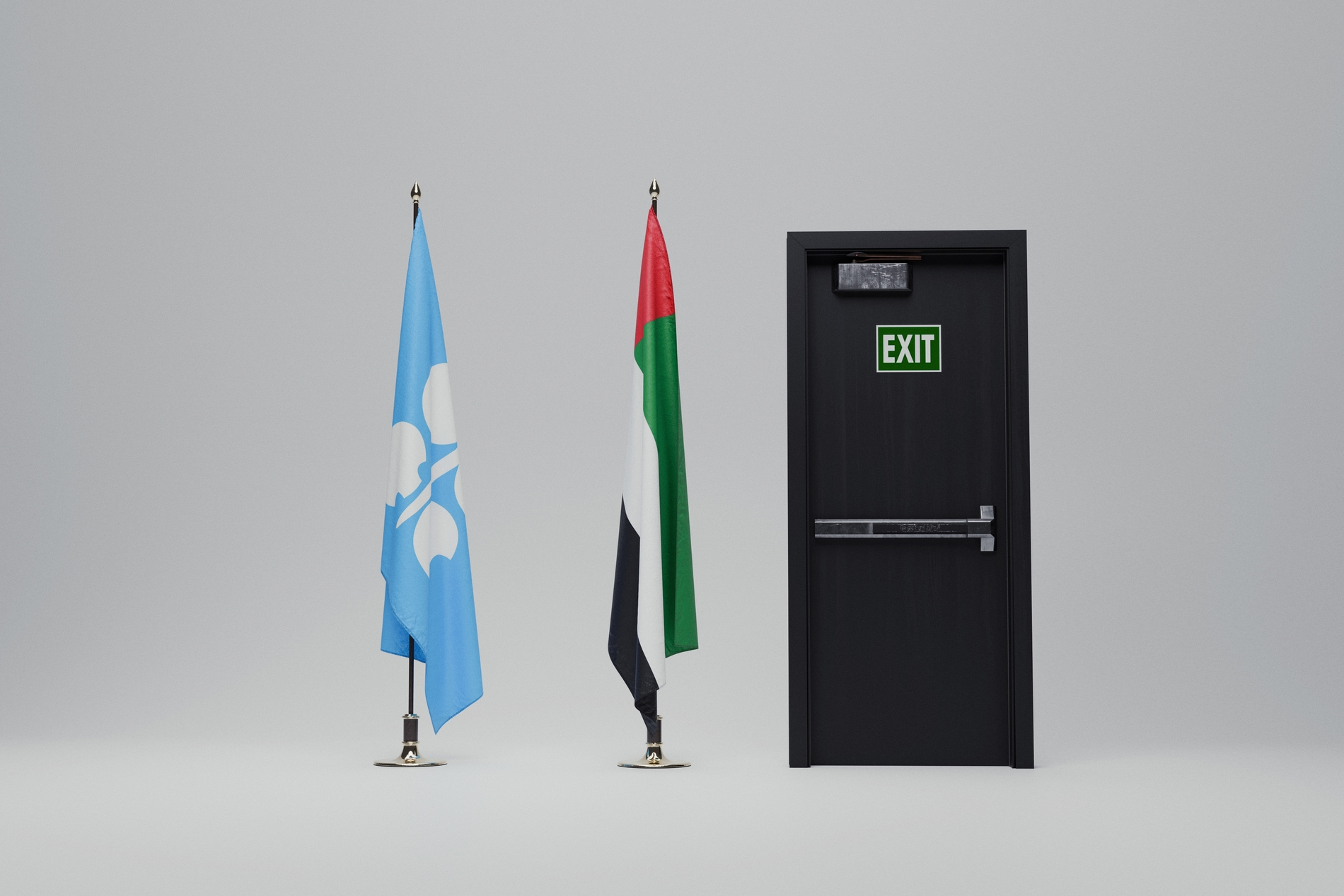
UAE quit OPEC and OPEC+ earlier this month, and the world is watching oil prices.
The United Arab Emirates’ historic departure from the Organization of the Petroleum Exporting Countries (OPEC) on May 1, 2026, has sent shockwaves through global energy markets, and analysts are now predicting that oil prices will finally fall.
But yet, a week and a half later, oil is still expensive. Brent crude is hovering above $100 a barrel. So what’s going on?
Nothing is getting cheaper anytime soon; a significant price drop will take time.
Why the UAE Left in the First Place
Credit: Shutterstock
This didn’t happen overnight. The frustration had been building for years.
Abu Dhabi’s National Oil Company (ADNOC) spent the last decade expanding its production capacity, reaching 4.85 million barrels per day. But under OPEC’s quota system, the UAE was only allowed to pump just under 3.5 million barrels per day. That’s a gap of over 1.3 million barrels every single day, sitting unused—day after day after day.
At current oil prices, that surplus oil can earn Abu Dhabi between $50 and $70 billion per year. This is what led to the OPEC exit.
Why Prices Haven’t Dropped Yet
Despite the historic exit, oil prices have remained stubbornly high. The reason is the closure of the Strait of Hormuz. It is the narrow waterway between Iran and Oman, through which roughly 20% of the world’s oil and gas normally transits.
Right now, amid the ongoing US-Israel war on Iran, that channel is badly disrupted. Iran has been targeting ships. Foreign-flagged vessels can’t freely pass through. On top of that, Donald Trump has imposed a blockade on the Strait. So the UAE cannot yet export the extra barrels it is now free to produce.
However, the UAE does have an alternative export route via the Fujairah terminal on the Gulf of Oman, which bypasses Hormuz entirely. But it can only move about 1.7 million barrels a day through there. That’s not enough to unlock the UAE’s full potential.
So for now, the OPEC exit is mostly symbolic. The taps are free, but the pipes are blocked.
The Drop Could Come When the Strait Reopens
The real impact of the UAE’s OPEC exit is expected to play out in 2027 and beyond. Once the Strait of Hormuz reopens, analysts warn of a significant supply surge.
The UAE could flood the market with up to 1.6 million bpd of additional production, equivalent to approximately 1.5% of the current global oil supply. ADNOC has already announced it’s accelerating $55 billion in upstream investment over 2026-2028. The target is 5 million barrels per day of capacity by 2027.

Credit: Shutterstock
Analysts at the Peterson Institute for International Economics say this surge “could pull down some pricing pressure depending on how demand holds up globally.” It won’t happen overnight. But it will happen.
A Weakened OPEC, A Volatile Market
The UAE leaving OPEC doesn’t just free up extra barrels. It weakens the cartel itself, which is a direct hit on Saudi Arabia.
The UAE was OPEC’s most important swing producer after Saudi Arabia. The one with enough spare capacity to actually move markets during a crisis. Without it, Rystad Energy’s head of geopolitical analysis, Jorge Leon, says OPEC will find it “increasingly difficult to calibrate supply and stabilise prices.”
Saudi Arabia feels this more than anyone. The IMF says Riyadh needs oil around $96 a barrel just to balance its budget, as it’s pouring money into Vision 2030, mega-cities, and an economic overhaul. The UAE doesn’t have that problem. Dubai runs on tourism, finance, and trade. Abu Dhabi can pump more, charge less, and still come out ahead.
That divergence is what makes this dangerous. More UAE oil in the market means lower prices, which punches a hole in Saudi Arabia’s budget. And the fact that the UAE didn’t even call Riyadh before announcing the exit made it personal.
The rivalry doesn’t stop at oil. The two countries are already backing opposite sides in Sudan and Yemen. The OPEC split is just the latest front.
What It Means for the World
For oil-importing nations, including Pakistan, India, and much of Asia, a future price drop would be welcome relief. Cheaper oil translates into lower inflation and reduced pressure on national budgets strained by the current energy shock.
For US consumers and the Trump administration, the UAE’s move aligns neatly with Washington’s stated goal of lowering energy prices and reducing OPEC’s power in global markets.
For investors, the picture is mixed. US upstream producers like ExxonMobil and Chevron benefit in the near term from high prices. High fuel prices are squeezing airlines and trucking companies. In the longer term, more supply from the UAE could eventually bring those costs down.
The Bottom Line
Oil prices may not drop today or even this month. The Strait of Hormuz remains the critical variable. But when it does reopen, the UAE will be positioned to pump freely, without OPEC’s cap, into a market hungry for supply.
