

Credit: Shutterstock
A few financial decisions can have an outsized effect on your financial life.
Personal finance can become unnecessarily complicated. There are hundreds of decisions you could make about spending, saving, debt, taxes, credit cards, insurance, and investing.
But not all decisions have the same financial impact.
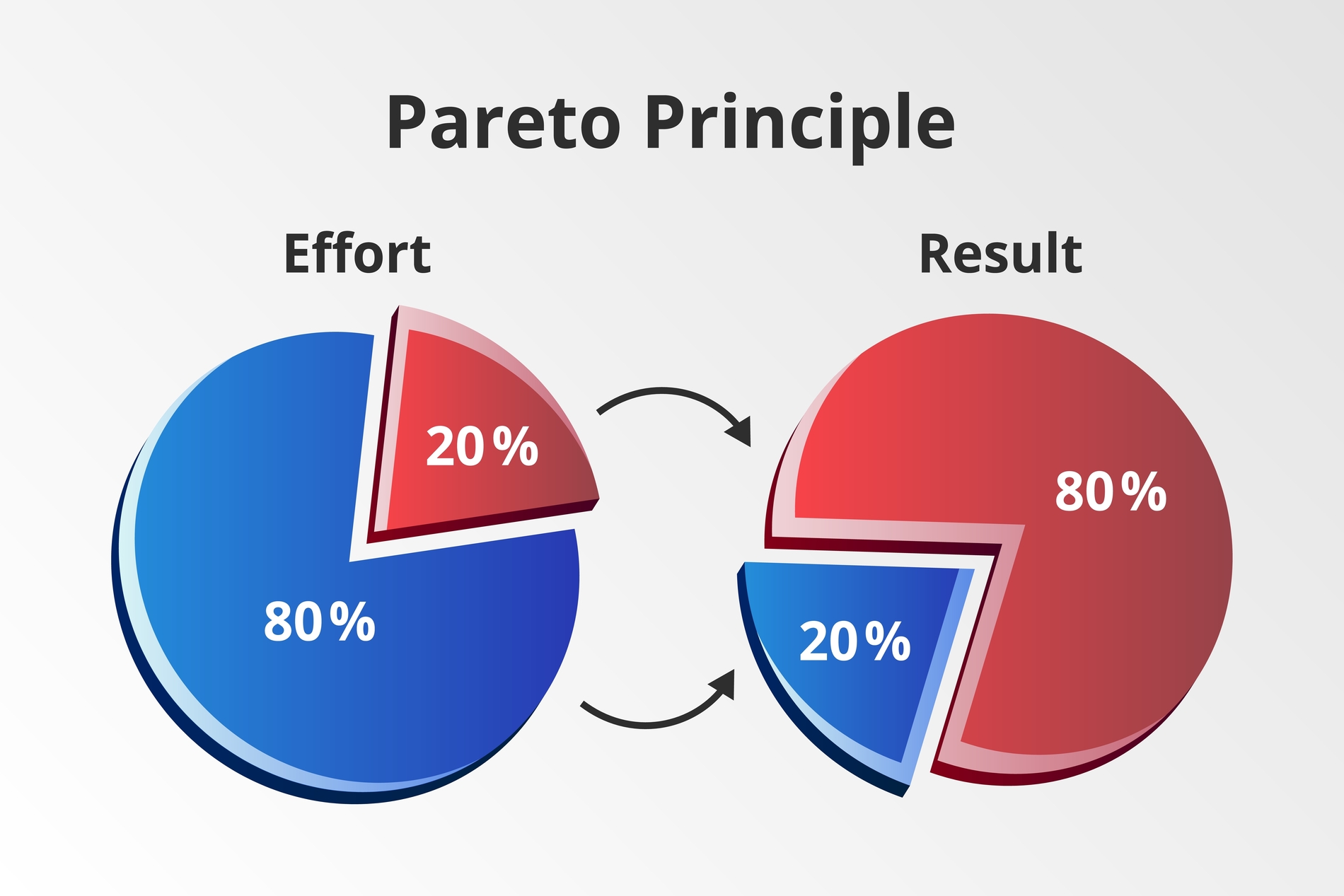
That is where the Pareto principle can help. Often called the 80/20 rule, this principle describes situations in which relatively small decisions produce disproportionately large consequences.
Credit: Shutterstock
Applied to personal finance, it does not mean exactly 20% of your decisions will produce exactly 80% of your wealth. In fact, it’s about identifying the spending that has the biggest impact and giving it most of your attention.
What Is the 80/20 Rule of Personal Finance?
The 80/20 rule of personal finance is a way to prioritize your money.
Instead of treating every financial decision as equally important, you focus first on what is most likely to affect your long-term financial position.
Those areas generally include:
- Your largest recurring expenses
- Your savings rate
- High-interest debt
- Emergency savings
- Retirement and other tax-advantaged accounts
- Investment diversification and fees
- Automatic financial systems
This Pareto principle is not an excuse to ignore small expenses. Small purchases can also add up, especially when they are frequent.
The point is that cutting a few dollars from a minor spending may matter far less than making a better decision about housing, transportation, debt, taxes, or retirement contributions.
The latest available Consumer Expenditure Survey illustrates the difference in scale. In 2024, housing took 33.4% of average U.S. household expenditures, and transportation ate another 17%. Together, those two categories accounted for more than 50% of average household spending. Food accounted for another 12.9%.
That is the Pareto principle in practice. Start with the big numbers.
1. Focus on Your Largest Expenses First
Look at your spending over the past 3 to 6 months and identify your largest expenses. For many households, these will include housing, transportation, food, insurance, healthcare, and debt payments.
Then ask where a change could produce a meaningful annual saving.
For example, you might be able to:
- Choose a less expensive vehicle when it is time to replace your current one.
- Requote auto or homeowners insurance.
- Reduce housing costs when moving or renewing a lease.
- Refinance or eliminate expensive debt when financially appropriate.
- Reduce spending on restaurant dining and food delivery.
- Cancel recurring subscriptions you no longer use.
Do not make a major housing or transportation decision solely to save money. Commute time, family commitments, safety, and quality of life also matter.
Tip: Look at annual costs, not just monthly prices. For example, only a $300 monthly difference in a car payment adds up to $3,600 a year.
2. Build a Financial Buffer Before Trying to Optimize Everything
An emergency fund is one of the highest-impact forms of financial protection.
The Consumer Financial Protection Bureau defines an emergency fund as cash set aside for unplanned expenses or financial emergencies, such as repairs, medical bills, or job loss.
No single emergency-fund amount is right for everyone. Hence, start by considering:
- How stable your income is
- Your essential monthly expenses
- Your insurance deductibles
- Your health needs
- Whether you own a home or vehicle that could require repairs
- How quickly you could be employed after a job loss
If you currently have no emergency savings, an initial cash buffer is a must rather than waiting until you can fund a large amount at once. After that, gradually build a reserve that can handle more serious disruptions.
Note: Keep emergency savings in a safe, accessible savings account rather than in investments you may need to sell in a crisis.
3. Give High-Interest Debt Priority
Not all debt costs the same.
A mortgage with a low fixed interest rate and a credit-card balance charging a much higher rate should not receive equal priority. Make all required minimum payments first. Then minimize interest expense by directing extra money toward the debt with the highest interest rate.
The CFPB suggests two common ways to pay down debt. The Highest-Interest Method focuses on the debt with the highest interest rate first, to save you more money on interest. In the Snowball Method, you pay the smallest balance first, which can help you stay motivated.
Under the 80/20 rule, you don’t spend too much time debating minor spending decisions while expensive debt keeps accumulating interest.
Be aware of these numbers for every debt you have:
- Outstanding balance
- Interest rate or APR
- Minimum payment
- Whether the rate is fixed or variable
- Any fees or prepayment restrictions
Then direct extra payments deliberately.
4. Capture the Biggest Tax and Retirement Opportunities
Once your cash flow is stable and high-interest debt is under control, focus on tax-advantaged accounts. If your employer offers a retirement plan, contribute enough to receive the full 401(k) match, then consider other accounts, such as an IRA or HSA.
For 2026, you can contribute up to $24,500 to most 401(k), 403(b), 457, and federal Thrift Savings Plan accounts. If you are 50 or older, you may be able to contribute more through catch-up contributions.
The 2026 IRA contribution limit is $7,500, or $8,600 if you are 50 or older. If you are eligible for an HSA, the 2026 contribution limit is $4,400 for self-only coverage and $8,750 for family coverage.
You do not need to contribute the maximum amount. Focus on saving what you can consistently and increasing your contributions as your finances improve.
The Pareto principle does not provide one universal order for funding a 401(k), IRA, HSA, emergency fund, or paying off debt. Hence, prioritize the option that offers the greatest benefit based on your debt, employer benefits, taxes, and financial goals.
5. Keep Your Investment Strategy Simple, Diversified, and Cost-Aware
You do not need a complicated portfolio to apply the 80/20 principle effectively.
For long-term investors, several basic decisions matter more than following daily market signals. These decisions include:
- How much you invest
- How consistently you invest
- Your asset allocation
- Diversification
- The fees you pay
Diversification can reduce the overall risk of an investment portfolio, while appropriate asset allocation depends on factors including your time horizon and risk tolerance.
Investment fees also need to be considered because they reduce the amount of money that remains invested and earning returns.
For example, $100,000 growing at 4% annually for 20 years would end at approximately $208,000 with a 0.25% annual fee, $198,000 with a 0.50% fee, and $179,000 with a 1.00% fee. It shows how different fee levels can affect the same hypothetical investment over time.
This does not mean the lowest-cost investment is automatically the best choice. You must consider costs alongside the investment’s strategy, risks, services, tax consequences, and suitability.
But fees are one variable investors can examine and compare before investing.
6. Automate the Decisions You Want to Repeat
The Pareto principle works particularly well when your most important transactions occur automatically. Instead of relying on motivation every month, you might automate:
- Contributions to a workplace retirement plan
- Transfers to an emergency savings account
- IRA or brokerage contributions
- Extra debt payments
- Regular bill payments
- Contributions toward short-term goals
Automation does not mean ignoring your finances. It means making the desired action your normal setting.
For example, if you receive a raise, consider increasing your retirement contribution or automatic savings transfer before your spending adjusts to the higher income.
A Practical 80/20 Order of Operations
No perfect sequence applies to every household, but this framework can help you decide where to focus.
- First, protect the basics. Pay essential bills, make required debt payments, maintain necessary insurance, and build an emergency cash cushion.
- Second, address obvious financial leaks. High-interest debt, major unnecessary recurring costs, overdraft fees, late fees, and unused subscriptions require attention.
- Third, use valuable employer benefits. Understand your 401(k) match and other workplace benefits.
- Fourth, strengthen your financial safety margin. Keep building emergency savings according to your household’s risks.
- Fifth, increase long-term investing. Use appropriate tax-advantaged accounts and a diversified investment strategy as per your goals.
- Finally, optimize smaller details. Once the major pieces are working, improving smaller expenses and account features can still produce useful savings.
The order may change. Someone facing 25% credit-card debt has a different priority than someone with no consumer debt and six months of cash savings. A worker receiving a generous employer match faces different trade-offs than a self-employed person without one.
What the Pareto Principle Does Not Mean
The 80/20 rule can be misleading when treated too literally.
It does not mean:
- Exactly 20% of your actions will create 80% of your wealth.
- You should save exactly 20% of your income.
- Small expenses never matter.
- You can ignore budgeting.
- Investing alone can compensate for persistent overspending.
- One financial strategy is appropriate for everyone.
Pareto Principle is a prioritization method. Its value comes from asking a better question:
The Bottom Line
Using the Pareto principle with your money means concentrating your effort where it can produce the greatest financial benefit. You do not need to make every financial decision perfectly. You need to identify the decisions that matter most and make them well, consistently, and early enough for the benefits to accumulate.
